
When sourcing gondola shelving for a supermarket, hypermarket, or retail store, you will inevitably encounter two terms: main frame (also called a starter unit or end unit) and add-on frame (also called a middle unit or extension unit). Understanding the structural difference between these two — and knowing when to use each — can significantly affect your total cost, installation timeline, and store layout flexibility.
What Is a Main Frame?
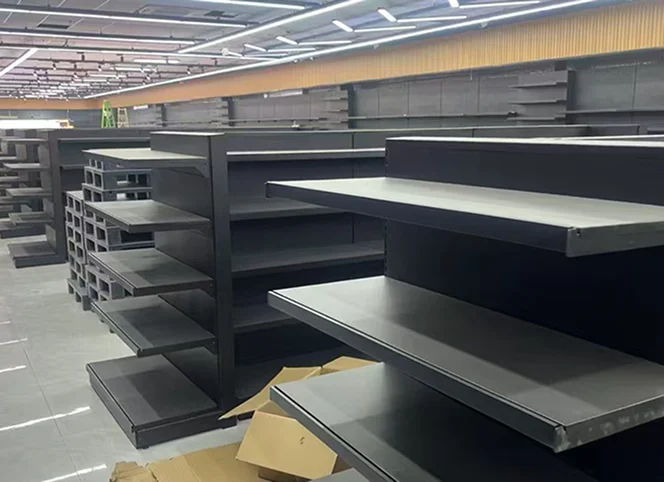
A main frame, also referred to as a starter unit or end unit, is a structurally complete, self-supporting gondola bay. It is designed to stand independently and anchor the start or end of a gondola run.
A standard main frame includes:
- Two full upright panels (the vertical steel columns that hold the shelves)
- Two base feet that provide lateral stability and anchor the unit to the floor
- All necessary shelf bracket connectors built into both uprights
- A full-width top cap or top shelf rail
Because a main frame carries two independent uprights, it is structurally complete and can bear load even when placed alone. This makes it suitable for standalone display islands, end-of-aisle positions, or any location where a shelving run terminates.
What Is an Add-On Frame?
An add-on frame — also called a middle unit or extension unit — is designed to extend an existing gondola run by sharing one upright panel with an adjacent unit. It cannot stand independently.
An add-on frame includes:
- One independent outward-facing upright panel
- One shared back-to-back upright (shared with the next unit in the run)
- A single base foot on the outward side
- Shelf bracket connectors on both uprights
The key consequence of the shared upright design is cost: an add-on frame uses roughly 35–45% fewer steel components than a main frame for the same bay width, which directly reduces your per-bay cost. For long gondola runs in a large supermarket, this saving compounds significantly across hundreds of bays.
"For a 10-bay gondola run, you need exactly 2 main frames and 8 add-on frames — not 10 main frames. Ordering all main frames is one of the most common — and most expensive — mistakes first-time retail buyers make."
— JBX Shelf Export Engineering Team
Key Structural Differences at a Glance
| Feature | Main Frame | Add-On Frame |
|---|---|---|
| Uprights per bay | 2 (full pair) | 1 independent + 1 shared |
| Base feet | 2 | 1 |
| Self-supporting | Yes | No — must attach to another unit |
| Typical unit cost | Higher (baseline) | 30–45% lower per bay |
| Best use | Run ends, standalone islands | Middle bays in a continuous run |
How to Plan Your Store Layout Correctly
The standard formula for any gondola run is:
Every run, regardless of length, must begin and end with a main frame. The number of add-on frames in between depends on how many bays you need.
Examples:
- 4-bay run: 2 main frames + 2 add-on frames
- 8-bay run: 2 main frames + 6 add-on frames
- 12-bay run: 2 main frames + 10 add-on frames
For a store with 20 gondola runs of 8 bays each, you need a total of 40 main frames and 120 add-on frames — not 160 main frames. The material and freight cost difference is substantial.

3 Common Mistakes When Ordering
Based on our experience supplying shelving to buyers across 50+ markets, these are the ordering errors we see most frequently:
- Ordering all main frames for a long run. This inflates material cost by 30–45% per bay and is completely unnecessary for middle positions in a run. Always calculate how many add-on frames your runs require before placing an order.
- Mixing upright gauges between suppliers. Main frames and add-on frames must use compatible upright gauges and connection systems. If you source main frames from one supplier and add-ons from another, you risk mismatches that require on-site modification or complete replacement.
- Forgetting standalone or end-cap positions. Wall-mounted shelving runs that terminate against a wall still require a main frame at the wall end. End-of-aisle promotional positions — gondola ends — always need a main frame. Buyers often only count the in-aisle bays and forget these positions entirely.
Key Takeaways
- Main frames are self-supporting; add-on frames must connect to another unit
- Every gondola run starts and ends with a main frame
- Add-on frames cost 30–45% less per bay — use them for all middle positions
- Always match upright gauge and connection system across your entire order
- Request a bay layout drawing from your supplier before confirming quantities
What to Ask Your Supplier
Before placing a purchase order for gondola shelving, ask your supplier for the following in writing:
- Upright gauge (thickness): typically 0.8 mm, 1.0 mm, or 1.2 mm. Heavier gauge uprights carry higher load and last longer in high-traffic environments.
- Bay width and depth options: standard widths are 900 mm and 1,000 mm; standard depths are 300 mm, 400 mm, and 500 mm.
- Maximum shelf load rating: critical for heavy FMCG categories like beverages, canned goods, or bulk items.
- Surface finish: powder coat or chrome plating. Powder coat offers better durability in humid environments; chrome delivers a premium visual finish.
- A dimensioned bay layout drawing: showing the position and count of main frames and add-on frames across your entire floor plan.
Sourcing Gondola Shelving for Your Store?
JBX Shelf manufactures supermarket gondola shelving in Changshu, Suzhou — available in both standard and custom configurations. Share your floor plan and our export team will provide a full bay layout drawing and quotation within 24 hours.